Protocols
Calls
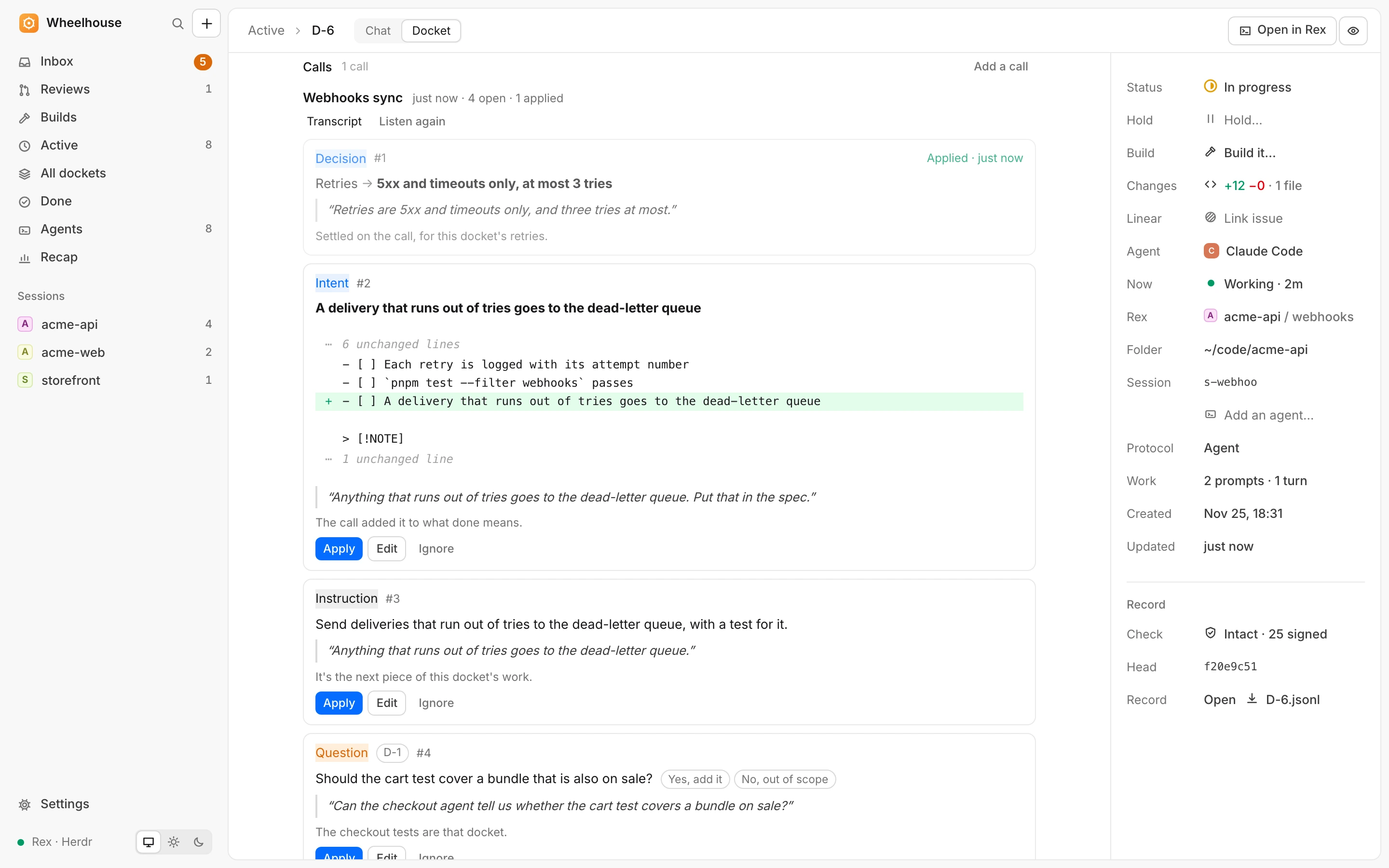
Calls happen in a docket's life. Give it the call's transcript, and the Listener proposes what the call settled for it, each quoting the call, for you to apply, edit or ignore.
As a docket’s intent and design move, its people meet to talk the changes through. The call settles things: what done now means, a decision, the next piece of work for its agents, a question for them. Give the docket the call’s transcript and its Listener reads it against that docket (its whole intent, the decisions in force, its agents and what happened lately), then proposes each of those things, quoting the part of the call it came from. You Apply, Edit then apply, or Ignore each one. Nothing changes until you do.
Adding a call
Section titled “Adding a call”- On a docket: Add a call… in its properties (or Add a call on its
Calls section, once it has one). Paste the transcript, drop its file on the
box, or Choose file… (
.txt,.vtt,.srt,.md). Give it a title, or it’s called “Call” and the day. - Anywhere: Add a call’s transcript in ⌘K, or + then Call. It’s about the docket you’re on; pick another under About, or No one docket for a call that isn’t about any one.
- In Wheelhouse.app: the same, and Add a Call’s Transcript… in ⌘K.
- From a terminal:
wh call notes.txt --docket D-41 --title "Webhooks sync", or pipe it in withwh call - --docket D-41.
The docket keeps the transcript (up to 400 KB) under its files’ Calls, pinned by its hash, and the docket’s page lists its calls, newest first, each with its transcript and what the Listener proposed from it. Its Activity says when each was added and what came of it.
A call that isn’t about any one docket (a planning call, say) gets a docket of its own, and the Listener proposes for whichever of your open dockets it was about.
What the Listener proposes
Section titled “What the Listener proposes”| Kind | When you apply it |
|---|---|
| Intent | The docket’s intent, as the call revised it, becomes its next version. The card shows the change as a diff against the intent now |
| Decision | It’s recorded as /decide Subject: answer would record it: it stands under the docket’s Decisions, goes in every agent’s brief, and the agents on it are told |
| Instruction | It’s sent to the docket’s agents as @all would send it, waiting for each to finish its turn |
| Question | It’s asked as /ask asks it, with the options as buttons. Their answer stands under Decisions |
| Task | Only for separate work the call asked for that no open docket covers: it opens a docket with that title, its intent written from the call, and the quote that asked for it |
Most proposals are for the call’s own docket. When the call settled something about another open docket, the proposal names it. An intent change is only ever for the call’s own docket, and at most one per call.
Each proposal says why, and quotes the call. A quote that isn’t in the transcript, sentence by sentence, is flagged Not in the transcript: read that one twice.
Edit changes the words before applying: the revised intent, the subject and what was decided, the instruction, the question and its options, or a task’s title and intent, and the docket for anything but an intent change. The record keeps what you changed. A proposal is answered once.
The Listener
Section titled “The Listener”The Listener is Claude Code, run headless with no tools, no MCP servers, no settings and no hooks. It’s given the call’s docket in full, a line on each of your other open dockets (its title, the start of its intent, and its decisions in force), and the transcript, and it can only answer with proposals. Its answer is checked like any untrusted input: kinds, sizes, dockets that are really open, and quotes against the transcript.
If it fails (Claude Code isn’t signed in, or it timed out), the call says why; Listen again reads it again, against the docket as it is now, and doesn’t propose again what it proposed already.
Coming later
Section titled “Coming later”Capturing a call’s audio on the Mac, and a Listener that steers agents while the call is still going.